 Ayarında
Bulgur pilaf calories
1 serving · 180 g: about 210–320 kcal. 147 kcal per 100 g: 4.1 g protein, 24.9 g carbohydrate, 4.5 g fat.
Estimated recipe. The values are calculated from the standard home recipe below, with the ingredients’ USDA values. A home version can differ by ±20% with the recipe, oil and portion.
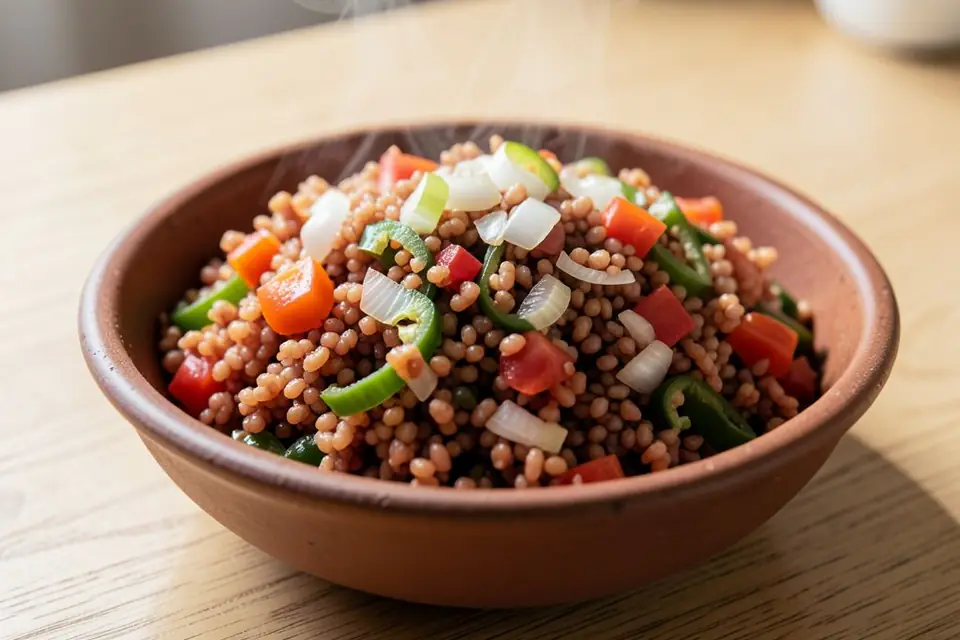
In portions
| Portion | Amount | Calories |
|---|---|---|
| 1 serving | 180 g | 210–320 kcal |
| 1 tablespoon | 25 g | 30–40 kcal |
Nutrition facts (100 g)
| Energy | 147 kcal |
|---|---|
| Protein | 4.1 g |
| Carbohydrate | 24.9 g |
| Sugar | 1.1 g |
| Fiber | 4.2 g |
| Fat | 4.5 g |
| Saturated fat | 1.3 g |
| Sodium | 305 mg |
Where the calories come from: protein 10% · carbohydrate 64% · fat 26%.
Depending on the oil
Oil makes up a large share of the calories (~24%). 1 serving · 180 g: with less oil about 240 kcal, normal 270 kcal, with more oil about 290 kcal. Ayarında asks “How oily was it?” when you log it.
Which recipe is it calculated from?
The recipe’s ingredients (raw weight) and their calories:
| Ingredient | Amount | Calories |
|---|---|---|
| Bulgur (raw) | 320 g | 1,094 kcal |
| Onion | 80 g | 32 kcal |
| Green pepper | 40 g | 8 kcal |
| Tomato | 150 g | 27 kcal |
| Tomato paste | 16 g | 13 kcal |
| Butter | 20 g | 143 kcal |
| Sunflower oil | 26 g | 230 kcal |
| Water | 600 ml | 0 kcal |
| Salt | 8 g | 0 kcal |
| Total | 1,548 kcal |
The cooked dish weighs 1,050 g in total: 147 kcal per 100 g, so 1 serving · 180 g has about 270 kcal.
Source: Ayarında recipe; ingredient values from USDA FoodData Central. The same food can vary by ±20% with its variety, recipe and brand.
Frequently asked questions
Bulgur pilaf: how many grams and calories in 1 serving?
1 serving is about 180 g on average and has about 210–320 kcal. Made with less oil it’s about 240 kcal, with more oil about 290 kcal.
Bulgur pilaf: how many calories in 100 grams?
Per 100 g there are 147 kcal, 4.1 g of protein, 24.9 g of carbohydrate and 4.5 g of fat.
Bulgur pilaf: how much protein does it have?
Per 100 g there are 4.1 g of protein; 1 serving (180 g) has about 7 g of protein. About 10% of its calories come from protein.
Bulgur pilaf: does it make you gain weight?
No single food makes you gain weight on its own; your weight depends on the day’s total calories. 1 serving (180 g) has about 270 kcal: about 13% of a 2,000 kcal day (the reference on nutrition labels). Its energy density is low (1.5 kcal per gram): you can eat more of it for the same calories. More than half of its calories come from carbohydrate.
Write what you ate, let Ayarında do the math
Just write “2 eggs and a slice of cheese for breakfast” or take a photo of your plate; Ayarında calculates the calories and tells you what you can eat for the rest of the day.
Meal ideas with it
- İmam bayıldı, bulgur pilaf, yogurt ~640 kcal
- Grilled köfte, bulgur pilaf, shepherd’s salad ~690 kcal
- Chickpea stew with meat, bulgur pilaf, yogurt ~620 kcal
- Forest kebab and bulgur pilaf ~610 kcal
Similar foods
Among rice and pasta, it is one of the lightest: 147 kcal per 100 g (average 157 kcal). Higher-protein options: Chicken and chickpea pilaf (~510 kcal, 21 g protein), Buttered pasta (~480 kcal, 14 g protein).
- Boiled brown rice 1 serving ~180 kcal · 4 g protein
- Boiled rice (plain) 1 serving ~200 kcal · 4 g protein
- Bulgur pilaf 1 serving ~270 kcal · 7 g protein
- Boiled whole wheat pasta 1 serving ~270 kcal · 11 g protein
- Boiled pasta (plain) 1 serving ~320 kcal · 12 g protein
- Pasta with tomato sauce 1 serving ~390 kcal · 13 g protein
- Erişte (homemade noodles with butter) 1 serving ~420 kcal · 13 g protein
- Baked pasta 1 slice ~430 kcal · 18 g protein
- Chicken and chickpea pilaf 1 serving ~510 kcal · 21 g protein